Trust & Privacy
Where does your patient information actually go?
Know where every piece of your work is kept.
Lithaya keeps clinical work on your side wherever it can. This page sets out what stays on your computer, what is sent for AI processing, what Lithaya stores, and the safeguards built into the product.
Your work
The case you analyze
Your account
Will your cases be used to train AI?
Our commitments
Your library is yours
Your saved cases are stored in the Lithaya folder you choose. We do not keep a copy, and we do not need one to run the service.
No identifiable details needed
Lithaya works on the clinical picture. Before anything is sent, it removes common identifiers such as names, phone numbers, ID numbers and dates of birth, and asks you about any word that may be a name.
No selling, no training
We do not sell personal information. Your cases are not used to train AI models, by us or by our AI provider.
Encrypted connections
The website and the apps are served only over HTTPS. Everything sent for AI processing, and every source and label lookup, is encrypted in transit.
Not kept after your response
Case text passes through Lithaya to our AI provider only to produce your response. Neither Lithaya nor our AI provider keeps it afterwards.
Clinician responsibility
Lithaya is a reference tool. You remain responsible for clinical decisions and for meeting your own privacy obligations.
Built-in safeguards
Who else can use this?
Professional use, confirmed every time.
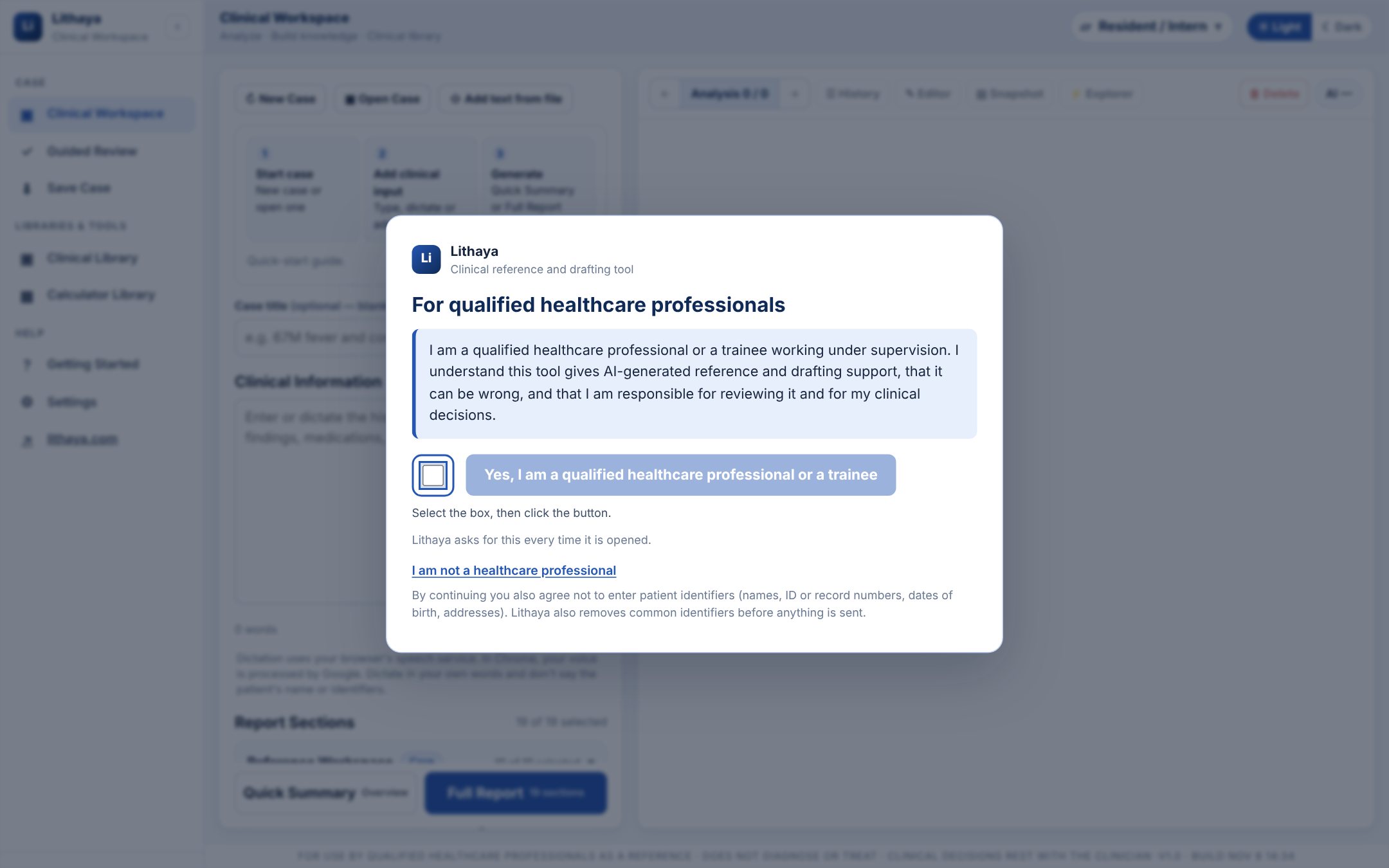
Each time the Clinical Workspace opens, you confirm that you are a qualified healthcare professional or a trainee working under supervision, and that you are responsible for reviewing what it produces. Until you do, nothing on the page can be used. People who are not healthcare professionals are told the tool is not for them.
Regulatory status
Lithaya is an informational reference, drafting and learning tool. It has not been approved, cleared or registered as a medical device in any country, and it is not intended to diagnose or treat.
Report a security concern
Email [email protected] with "Security" in the subject line. Please do not include patient information.